

Skip to content
-
Subscribe to our newsletter & never miss our best posts. Subscribe Now!
99% Purity Peptide 99% Purity Peptide 99% Purity Peptide
  • Home
  • Shop
  • Features
  • Terms and conditions
  • Pages
  • Home
  • Shop
  • Features
  • Terms and conditions
  • Pages
Close

Search

Trending Now:
Retatrutide Tirzepatide Nad+ MOTS-c Liraglutide HGH IGF-1 LR3 GHK-Cu DSIP Bronchogen Kisspeptin-10
  • Weight Loss & Metabolic
  • Longevity & Anti-Aging
  • Aesthetics & Performance
  • Neuroscience & Nootropics
Subscribe
My account
99% Purity Peptide 99% Purity Peptide 99% Purity Peptide
  • Home
  • Shop
  • Features
  • Terms and conditions
  • Pages
  • Home
  • Shop
  • Features
  • Terms and conditions
  • Pages
Close

Search

Trending Now:
Retatrutide Tirzepatide Nad+ MOTS-c Liraglutide HGH IGF-1 LR3 GHK-Cu DSIP Bronchogen Kisspeptin-10
  • Weight Loss & Metabolic
  • Longevity & Anti-Aging
  • Aesthetics & Performance
  • Neuroscience & Nootropics
Subscribe
My account
Home/Weight Loss & Metabolic/AICAR Peptide: Research in Metabolic Activation and Cellular Energy Homeostasis
Weight Loss & Metabolic

AICAR Peptide: Research in Metabolic Activation and Cellular Energy Homeostasis

By gruppo di ricerca
October 1, 2025 3 Min Read
0

May 8, 2026

AICAR (Aminoimidazole carboxamide ribonucleotide) is a synthetic analog of adenosine monophosphate (AMP) that serves as a potent metabolic regulator. Research indicates that AICAR is a cell-permeable activator of AMP-activated protein kinase (AMPK), a master switch in cellular energy metabolism. Unlike other metabolic agents, AICAR is recognized in research for its ability to mimic the effects of physical exercise at a cellular level, often referred to in literature as an “exercise mimetic.”

Preclinical investigations have demonstrated that AICAR can shift cellular metabolism from glucose utilization to fat oxidation, potentially improving endurance and insulin sensitivity in research models. Its role in regulating energy balance makes it a primary focus for studies involving metabolic syndrome, type 2 diabetes, and cardiovascular health.

What is the mechanism by which AICAR exerts its effects?

The primary mechanism underlying AICAR’s action involves the direct stimulation of AMPK. By mimicking a state of low cellular energy (high AMP levels), AICAR triggers a cascade of signaling pathways designed to restore energy homeostasis.

Upon introduction into a research model, AICAR appears to:

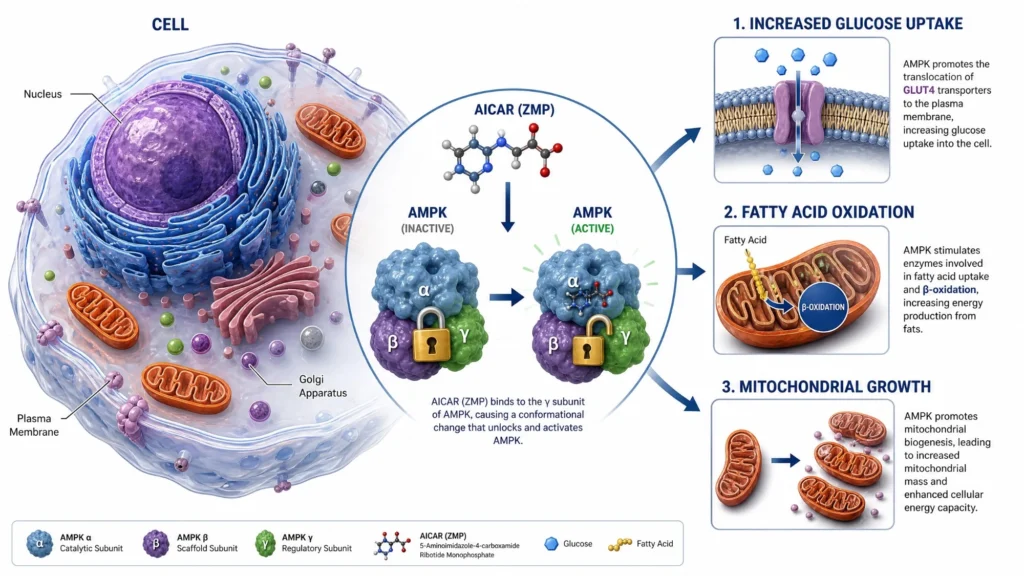
  1. Activate AMPK: AICAR is converted intracellularly into ZMP, which mimics the effect of AMP, binding to and activating the AMPK enzyme complex.
  2. Stimulate Glucose Uptake: It promotes the translocation of GLUT4 (glucose transporter 4) to the cell membrane, facilitating glucose entry into skeletal muscle independent of insulin.
  3. Promote Fatty Acid Oxidation: By inhibiting Acetyl-CoA carboxylase (ACC), AICAR reduces malonyl-CoA levels, thereby increasing the transport of fatty acids into the mitochondria for energy production.
  4. Enhance Mitochondrial Biogenesis: Chronic activation of AMPK via AICAR is believed to upregulate PGC-1α, leading to the creation of new mitochondria and increased aerobic capacity.
ampk_activation_diagram

How was AICAR discovered in research?

AICAR was originally studied as an intermediate in the de novo synthesis of purine nucleotides. However, its metabolic significance became clear in the 1980s and 90s as researchers began to identify the AMPK enzyme and its role as a “metabolic master switch.” Scientists discovered that by introducing AICAR, they could artificially activate this switch without the need for physical exertion or caloric restriction.

This discovery led to landmark studies in the late 2000s, where research models treated with AICAR showed a significant increase in running endurance—up to 44%—without prior training. These findings revolutionized the understanding of how chemical signals can influence physiological performance and tissue adaptation.

Research Studies on AICAR Peptide

AICAR and Exercise Mimicry in Skeletal Muscle

The role of AICAR in enhancing physical performance was investigated to determine if metabolic adaptations could occur in a sedentary state. In murine models, administration of AICAR for four weeks resulted in the transformation of muscle fibers into “slow-twitch” oxidative fibers. These fibers are more resistant to fatigue, suggesting that AICAR potentially reprogrammed the genetic expression of the muscle to favor endurance-based metabolism.

AICAR and Insulin Sensitivity

This study aimed to investigate the effects of AMPK activation on insulin resistance. Results indicate that AICAR administration can significantly improve glucose tolerance in models of diet-induced obesity. Mechanistically, by activating the AMPK pathway, AICAR appears to bypass insulin signaling defects, providing a secondary route for glucose disposal and reducing the metabolic burden on the pancreas.

Synopsis

AICAR (Aminoimidazole carboxamide ribonucleotide) appears to be a powerful tool for investigating the complexities of cellular energy regulation. By acting as a selective AMPK activator, it provides a unique window into the molecular pathways associated with exercise, fat oxidation, and glucose management. Further investigations are warranted to fully understand its impact on systemic energy balance and its potential to counteract metabolic decline in scientific research.


NOTE: These products are intended for laboratory research use only. This peptide is not intended for personal use. Please review and adhere to our Terms and Conditions before ordering.

Tags:

AICARExercise MimeticFat Oxidation
Author

gruppo di ricerca

Follow Me
Other Articles
ara290_photography
Previous

ARA-290 Peptide: Research in Innate Repair and Neuropathic Protection

adipotide_visualization
Next

Adipotide (FTTP) Peptide: Research in Targeted Adipose Tissue Vasculature

No Comment! Be the first one.

    Leave a Reply Cancel reply

    Your email address will not be published. Required fields are marked *

    Recent Posts

    • Adamax Peptide: Research in Neuroprotection and Cognitive Augmentation
    • Adipotide (FTTP) Peptide: Research in Targeted Adipose Tissue Vasculature
    • AICAR Peptide: Research in Metabolic Activation and Cellular Energy Homeostasis
    • ARA-290 Peptide: Research in Innate Repair and Neuropathic Protection
    • AOD9604 Peptide: Research in Lipolysis and Cartilage Regeneration

    Recent Comments

    No comments to show.

    Archives

    • October 2025
    • September 2025

    Categories

    • Aesthetics & Performance
    • Healing & Tissue Repair
    • Longevity & Anti-Aging
    • Neuroscience & Nootropics
    • Weight Loss & Metabolic

    Categories

    • Cosmetic (8)
    • Growth (19)
    • Metabolic (22)
    • Neuro (11)
    • Repair (15)
    • Support (2)
    • Systemic (8)
    Hi, I'm Alex. I work in API development research and have in-depth knowledge of the medical, peptide, and health fields.
    • X
    • Instagram
    • Facebook
    • YouTube
    Work Experience

    Shenzhen Research Institute

    Peptide development

    2021-present

    Luxora Digital

    API

    2019-2021

    Southern Medical University

    Support Specialist

    2017-2019

    Available for Hire
    Get In Touch

    Recent Posts

    • adamax_visualization
      Adamax Peptide: Research in Neuroprotection and Cognitive Augmentation
      by gruppo di ricerca
      October 1, 2025
    • hmg_vial.
      HMG: Research in Dual Gonadotropin Signaling and Fertility Models
      by gruppo di ricerca
      September 30, 2025
    • hgh_vial
      HGH: Research in Growth Signaling and Cellular Regeneration
      by gruppo di ricerca
      September 30, 2025
    • hexarelin_vial
      Hexarelin Acetate: Research in GH Secretion and Cardioprotection
      by gruppo di ricerca
      October 1, 2025

    search...

    Information

    • About Me
    • My story
    • Awards & Achievement
    • Contact

    Welcome to the ultimate source for fresh perspectives! Explore curated content to enlighten, entertain and engage global readers.

    • Facebook
    • X
    • Instagram
    • LinkedIn

    Discover

    • Weight Loss & Metabolic
    • Longevity & Anti-Aging
    • Aesthetics & Performance
    • Neuroscience & Nootropics

    Latest Posts

    • Tirzepatide Peptide: A Dual-Agonist Approach to Metabolic Research and Weight Regulation
      Tirzepatide is a novel, synthetic peptide that research indicates is… Read more: Tirzepatide Peptide: A Dual-Agonist Approach to Metabolic Research and Weight Regulation
    • Retatrutide Peptide: Research in Triple-Agonist Metabolic Regulation
      May 8, 2026 Retatrutide (also known as LY3437943) is an… Read more: Retatrutide Peptide: Research in Triple-Agonist Metabolic Regulation
    • Ipamorelin Peptide: Research in Selective Growth Hormone Stimulation
      May 13, 2026 Ipamorelin is a synthetic pentapeptide ($Aib-His-D-2-Nal-D-Phe-Lys-NH_2$) that… Read more: Ipamorelin Peptide: Research in Selective Growth Hormone Stimulation

    Locate Us

    123 Demo Blvd, Miami, FL 4567, United States
    danielkimeuuk@gmail.com

    Pages

    • BPC-157 Peptide 10mg – Angiogenesis & Gastric Mucosal Integrity Research
    • SS-31 Peptide (Elamipretide) 50mg – Mitochondrial Cardiolipin Stabilization Research
    • HGH (Human Growth Hormone) 36iu – Somatotropic Signaling & Proteostasis Research
    • Tirzepatide 20mg – GIP & GLP-1 Receptor Dual Agonism Research
    • Retatrutide 60mg – High-Purity GIP & GLP-1 Dual Agonist for Metabolic Modeling

    Contact

    Phone

    +44 7591 782646

    Email

    danielkimeuuk@gmail.com

    Location

    Shenzhen University Longhua Bio-industry Innovation Research Institute Base

    Copyright 2026 — 99% Purity Peptide. We are a peptide chemical supplier. Statements on this site have not been evaluated by the FDA. Our products are not for human/animal use and are not intended to diagnose, treat, cure, or prevent any disease. Laboratory/In-Vitro Research Use Only.