

May 8, 2026
AOD9604 (Advanced Obesity Drug) is a synthetic peptide fragment derived from the C-terminal end of human growth hormone (hGH), specifically encompassing amino acids 177-191 with an added tyrosine at the N-terminal to stabilize the molecule. Research indicates that AOD9604 retains the potent fat-burning (lipolytic) properties of hGH while intentionally excluding its growth-promoting (mitogenic) and insulin-resistance-inducing effects.
Preclinical investigations have positioned AOD9604 as a unique agent in metabolic research, demonstrating an ability to stimulate fat metabolism without affecting blood glucose levels or stimulating IGF-1 production. Beyond its metabolic profile, recent studies have also explored its potential role in orthopedic research, specifically in the repair of cartilage and treatment of osteoarthritis.
What is the mechanism by which AOD9604 exerts its effects?
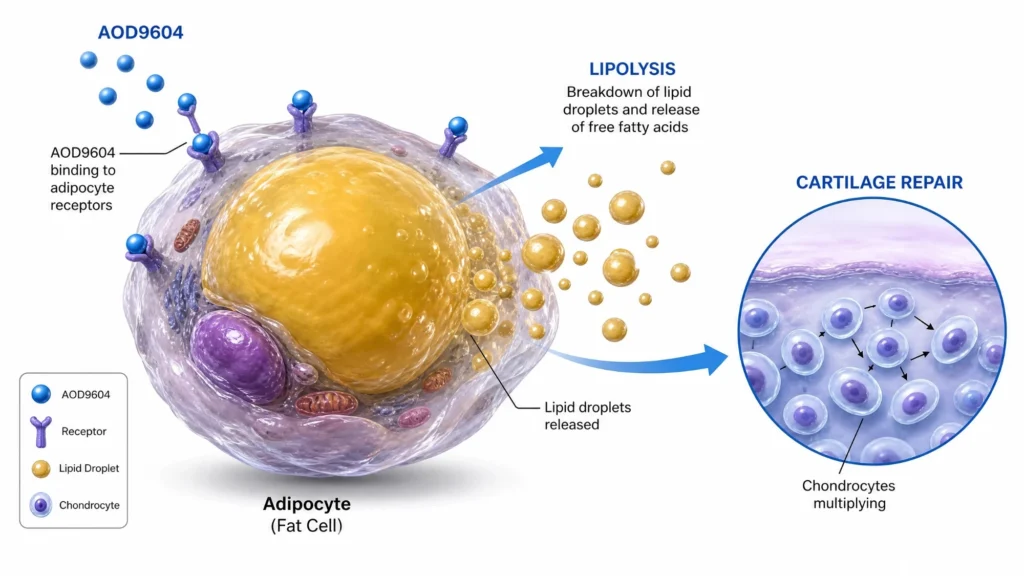
The primary mechanism underlying AOD9604’s action involves the stimulation of Lipolysis (the breakdown of fat) and the inhibition of Lipogenesis (the transformation of non-fatty foods into body fat).
Upon introduction into a research model, AOD9604 appears to:
- Stimulate Adrenergic Receptors: It is believed to mimic the way natural growth hormone regulates fat metabolism by interacting with specific beta-3 adrenergic receptors on adipocytes.
- Increase Metabolic Rate: It promotes the release of fat from obese adipose tissues more effectively than from lean tissues, suggesting a high degree of specificity for excess fat stores.
- Inhibit Lipogenesis: By disrupting the pathways that store triglycerides, it prevents the further accumulation of fat within the cells.
- Upregulate Cartilage Repair: In orthopedic research, AOD9604 has been observed to stimulate the proliferation of chondrocytes (cartilage cells) and enhance the production of proteoglycans, which are essential for joint health.
How was AOD9604 discovered in research?
AOD9604 was developed through “fragmentation” research conducted at Monash University. Scientists sought to isolate the specific part of the 191-amino acid human growth hormone molecule responsible for its metabolic effects. By isolating the 177-191 fragment, they discovered they could replicate the fat-loss benefits of GH without the side effects associated with the full-length hormone, such as increased risk of diabetes or abnormal bone growth.
This discovery led to several human clinical trials in the early 2000s aimed at treating obesity. While the peptide demonstrated an excellent safety profile and successfully induced fat loss, research shifted toward its diverse applications in regenerative medicine and metabolic optimization.
Research Studies on AOD9604 Peptide
AOD9604 and Adipose Reduction
The role of AOD9604 in localized fat reduction was investigated to determine its impact on visceral fat mass. In murine models of obesity, daily administration resulted in a significant reduction in body fat without changing food intake. Researchers highlighted that unlike other fat-loss agents, AOD9604 did not appear to trigger the “starvation response” or cause muscle wasting, suggesting a highly selective metabolic action.
AOD9604 and Osteoarthritis Repair
This study aimed to investigate the regenerative potential of AOD9604 in joint health. When injected into the joints of research models with collagen-induced arthritis, AOD9604 appeared to work synergistically with hyaluronic acid to reduce the severity of joint damage. Mechanistically, it appeared to promote the recovery of damaged cartilage surfaces, offering a promising avenue for studying non-surgical joint repair.
Synopsis
The AOD9604 peptide appears to be a sophisticated modulator of both lipid metabolism and tissue regeneration. By selectively harnessing the metabolic power of hGH without its systemic risks, AOD9604 provides a specialized tool for studying obesity reversal and cartilage homeostasis. Its dual-action profile warrants further investigation into its long-term impact on metabolic flexibility and musculoskeletal health in scientific research.
NOTE: These products are intended for laboratory research use only. This peptide is not intended for personal use. Please review and adhere to our Terms and Conditions before ordering.