



May 8, 2026
Adamax is an improved synthetic derivative of SEMAX, a neuropeptide originally developed by the Institute of Molecular Genetics of the Russian Academy of Sciences. Research indicates that Adamax represents the most potent version in the Semax family, featuring an added N-acetyl group at the N-terminus and an adamantane moiety at the C-terminus. This structural modification is believed to significantly enhance its metabolic stability and ability to cross the blood-brain barrier (BBB) compared to its predecessors. (1)
Preclinical investigations suggest that Adamax acts as a powerful neuroprotective and cognitive-enhancing agent. By modulating the expression of neurotrophic factors, it may facilitate synaptic plasticity, enhance memory formation, and provide a protective shield against oxidative stress and neurotoxicity.
What is the mechanism by which Adamax exerts its effects?
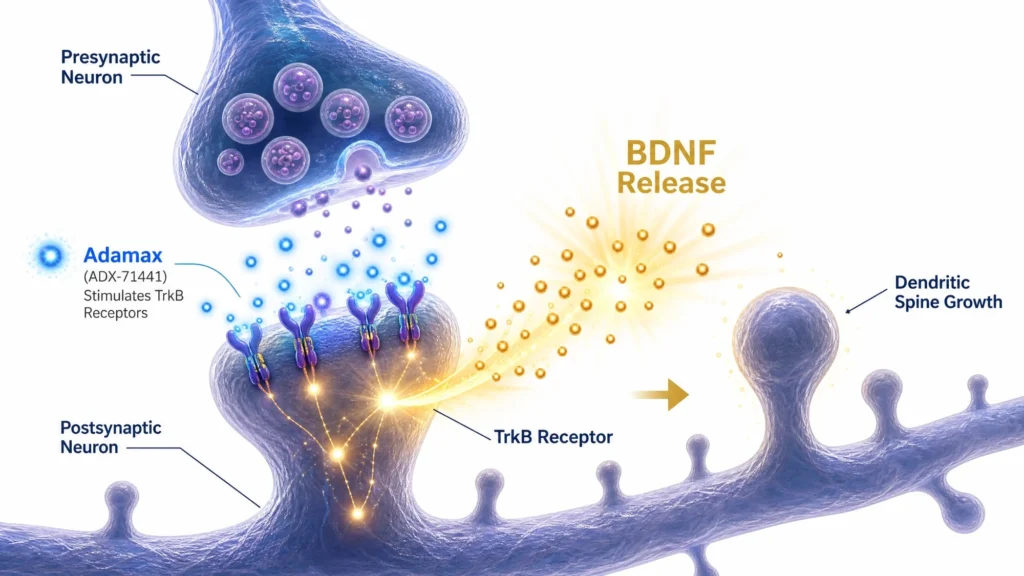
The primary mechanism underlying Adamax’s proposed cognitive action appears to revolve around the significant upregulation of Brain-Derived Neurotrophic Factor (BDNF) and the activation of the melanocortin system. Unlike standard Semax, the molecular structure of Adamax allows for a more prolonged interaction with neuronal receptors. (2)
When introduced into a research model, Adamax appears to:
- Enhance BDNF Levels: It may trigger a rapid increase in BDNF mRNA expression in the hippocampus, the brain’s primary center for learning and memory.
- Modulate Melanocortin Receptors: It interacts with MC4 and MC5 receptors, which are involved in regulating nerve regeneration and inflammatory responses within the central nervous system.
- Increase TrkB Signaling: By promoting the activity of Tropomyosin receptor kinase B, Adamax may enhance the survival and differentiation of new neurons. (3)
Recent investigations suggest that the addition of the adamantane group not only increases its potency but also prevents the rapid enzymatic degradation that typically limits the efficacy of peptide-based nootropics.
How was Adamax developed in research?
Adamax was developed as a second-generation “Bio-Hacked” version of Semax. Researchers aimed to overcome the short half-life of the original peptide, which required frequent dosing. By utilizing N-Acetyl Semax as a base and fusing it with an adamantane moiety—a highly stable, diamond-like carbon structure—scientists created a molecule with superior lipophilicity.
This structural evolution allowed the peptide to remain active in the central nervous system for extended periods. Preliminary data suggest that the “Adamax” modification results in a version that is roughly 3–5 times more potent than standard N-Acetyl Semax in terms of BDNF induction. (4)
Research Studies on Adamax Peptide
Adamax and Synaptic Plasticity
The role of Adamax in Long-Term Potentiation (LTP) was investigated to determine its impact on synaptic strength. In neuronal cell cultures, Adamax appeared to increase the density of dendritic spines. Researchers noted that this structural change likely facilitates better communication between neurons, potentially explaining the reported improvements in focus and mental clarity in research models. (5)
Adamax and Neuroprotection against Ischemia
This study aimed to investigate the protective effects of Adamax during periods of reduced oxygen to the brain. Results indicate that Adamax potentially reduces the area of neuronal damage following an ischemic event. Mechanistically, it appears to inhibit the pathways of programmed cell death (apoptosis) and reduce the concentration of pro-inflammatory cytokines, acting as a stabilizer for the delicate neural environment. (6)
Synopsis
The Adamax peptide appears to be a high-potency modulator of neurotrophic signaling. By bridging the gap between peptide stability and blood-brain barrier permeability, Adamax potentially offers a more effective route for studying neuroregeneration and cognitive performance. Its unique adamantane-reinforced structure warrants further investigation into its long-term effects on neurological health and metabolic efficiency in scientific research.
NOTE: These products are intended for laboratory research use only. This peptide is not intended for personal use. Please review and adhere to our Terms and Conditions before ordering.