



May 8, 2026
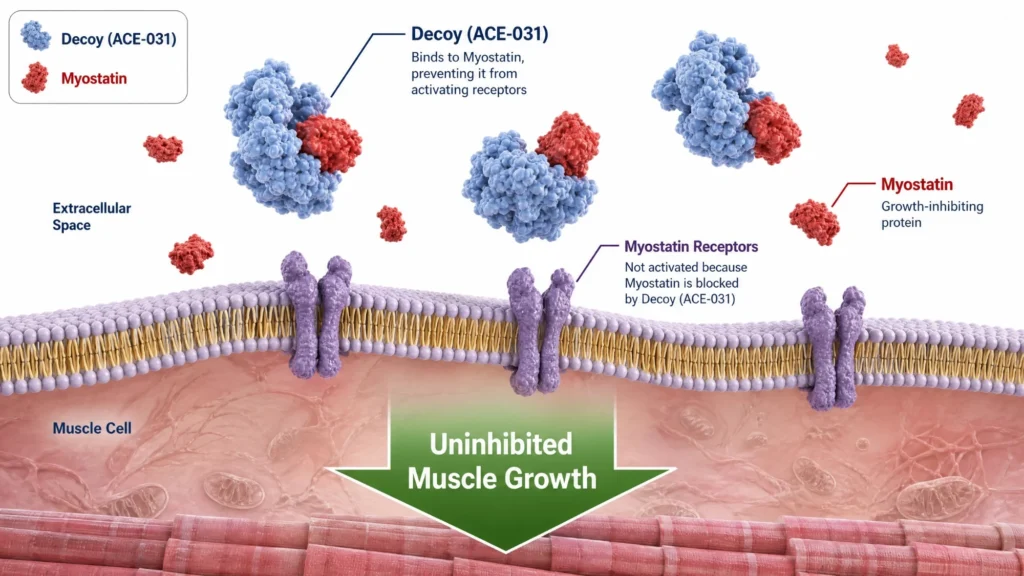
ACE-031 (also known as ACVR2B-Fc) is a soluble fusion protein consisting of the extracellular domain of the activin receptor type IIB (ActRIIB) fused to a human IgG1 Fc fragment. Research indicates that ACE-031 acts as a powerful “decoy” receptor, binding to specific proteins that naturally limit muscle growth—most notably Myostatin (GDF-8). Unlike traditional muscle-building agents, ACE-031 operates by neutralizing the body’s internal “brakes” on muscle development.
Preclinical investigations have positioned ACE-031 as a primary focus in neuromuscular research, demonstrating significant potential for increasing muscle mass and strength in models of muscular dystrophy and age-related muscle loss (sarcopenia).
What is the mechanism by which ACE-031 exerts its effects?
The primary mechanism underlying ACE-031’s action involves the competitive inhibition of the Transforming Growth Factor-beta (TGF-β) superfamily. By circulating in the bloodstream and binding to signaling molecules before they can reach their target cell receptors, ACE-031 prevents the inhibitory signals that stop muscle cell proliferation.
Upon introduction into a research model, ACE-031 appears to:
- Neutralize Myostatin: It binds to Myostatin (GDF-8), preventing it from attaching to the ActRIIB receptors on the surface of muscle cells.
- Inhibit Activin A: It also sequesters Activin A and other ligands that negatively regulate muscle growth, providing a broader anabolic effect than myostatin antibodies alone.
- Promote Hypertrophy: By removing these inhibitory signals, the peptide allows for an increase in protein synthesis and the proliferation of satellite cells, leading to increased muscle fiber size.
- Improve Bone Density: Some studies suggest that by modulating the ActRIIB pathway, ACE-031 may also have secondary beneficial effects on bone mineral density.
How was ACE-031 discovered in research?
ACE-031 was developed by researchers looking for therapeutic interventions for Duchenne Muscular Dystrophy (DMD) and other muscle-wasting diseases. The discovery of the “double-muscling” phenomenon in certain cattle breeds—caused by a natural mutation in the myostatin gene—provided the scientific basis for targeting the ActRIIB receptor.
Scientists engineered ACE-031 as a soluble version of the receptor itself. Instead of trying to modify the gene, they created a “soak” or “decoy” that would absorb the myostatin proteins before they could act on the muscle. This allowed researchers to study the effects of myostatin inhibition in a controlled, dose-dependent manner.
Research Studies on ACE-031 Peptide
ACE-031 and Rapid Muscle Mass Increase
The role of ACE-031 in healthy research models was investigated to determine the speed of muscle tissue accumulation. In early-phase clinical research, even a single dose appeared to result in measurable increases in the cross-sectional area of the thigh muscle within 29 days. Researchers noted that the increase in lean body mass was accompanied by a decrease in fat mass, suggesting a potential metabolic shift.
ACE-031 and Neuromuscular Resilience
This study aimed to investigate the potential for ACE-031 to mitigate muscle atrophy in models of physical inactivity. Results indicated that by maintaining myostatin inhibition, ACE-031 potentially preserved muscle fiber integrity and force-generating capacity even during periods of immobilization. Mechanistically, this suggests that the peptide may act as a protective agent against the degenerative processes of muscle wasting.
Synopsis
The ACE-031 peptide appears to be one of the most potent modulators of muscle homeostasis in current research. By functioning as a decoy receptor for myostatin and activins, it provides a unique mechanism for studying extreme muscle hypertrophy and the reversal of pathological muscle wasting. Further investigations are warranted to fully understand its long-term impact on vascular stability and systemic endocrine balance in scientific research.
NOTE: These products are intended for laboratory research use only. This peptide is not intended for personal use. Please review and adhere to our Terms and Conditions before ordering.