
Skip to content
-
Subscribe to our newsletter & never miss our best posts. Subscribe Now!
99% Purity Peptide 99% Purity Peptide 99% Purity Peptide
  • Home
  • Shop
  • Features
  • Terms and conditions
  • Pages
  • Home
  • Shop
  • Features
  • Terms and conditions
  • Pages
Close

Search

Trending Now:
5 Essential Tools Every Blogger Should Use Music Trends That Will Dominate This Year ChatGPT prompts – AI content & image creation trend Ghibli trend – viral anime-style visual trend
  • Dresses
  • Bottoms
  • Footwear
  • Accessories
Subscribe
My account
99% Purity Peptide 99% Purity Peptide 99% Purity Peptide
  • Home
  • Shop
  • Features
  • Terms and conditions
  • Pages
  • Home
  • Shop
  • Features
  • Terms and conditions
  • Pages
Close

Search

Trending Now:
5 Essential Tools Every Blogger Should Use Music Trends That Will Dominate This Year ChatGPT prompts – AI content & image creation trend Ghibli trend – viral anime-style visual trend
  • Dresses
  • Bottoms
  • Footwear
  • Accessories
Subscribe
My account
Home/Aesthetics & Performance/GHK-Cu Peptide: Research in Skin Regeneration and Tissue Repair
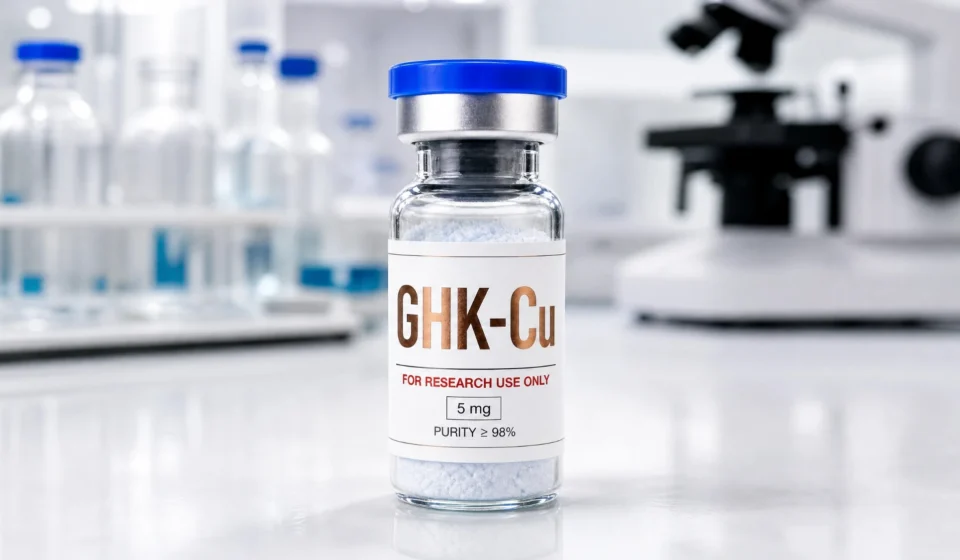
ghk_cu_vial
Aesthetics & Performance

GHK-Cu Peptide: Research in Skin Regeneration and Tissue Repair

By gruppo di ricerca
October 1, 2025 3 Min Read
0

May 13, 2026

GHK-Cu is a naturally occurring copper complex of the tripeptide glycyl-L-histidyl-L-lysine. Research indicates that this peptide is a potentially powerful modulator of tissue remodeling and antioxidant defense. Originally identified in human plasma, GHK-Cu exhibits a high affinity for copper (II) ions, forming a stable complex that is considered a key mediator of various cellular processes, including wound healing and anti-inflammation. Extensive preclinical studies utilizing animal and cellular models have indicated the potential efficacy of GHK-Cu in stimulating the synthesis of extracellular matrix components such as collagen and elastin.(1)

What is the mechanism by which GHK-Cu exerts its effects?

The mechanism underlying GHK-Cu’s proposed regenerative action appears to involve its potential to interact with the gene expression profiles of dermal fibroblasts. Upon presentation, GHK-Cu appears to penetrate the extracellular space and potentially modulate the activity of metalloproteinases and their inhibitors. This interaction appears to cause an increase in the production of collagen type I and III, as well as glycosaminoglycans, which are considered crucial for maintaining skin density and elasticity.

Recent investigations suggest that GHK-Cu also acts as a regulator of the inflammatory response. Studies suggest the potential involvement of the peptide in reducing the levels of pro-inflammatory cytokines, such as TNF-alpha and IL-6. Furthermore, GHK-Cu is believed to promote angiogenesis—the formation of new blood vessels—by potentially upregulating vascular endothelial growth factor (VEGF). This multifaceted approach appears to accelerate tissue repair and enhance the overall structural integrity of the skin barrier in research models.(1) (2)
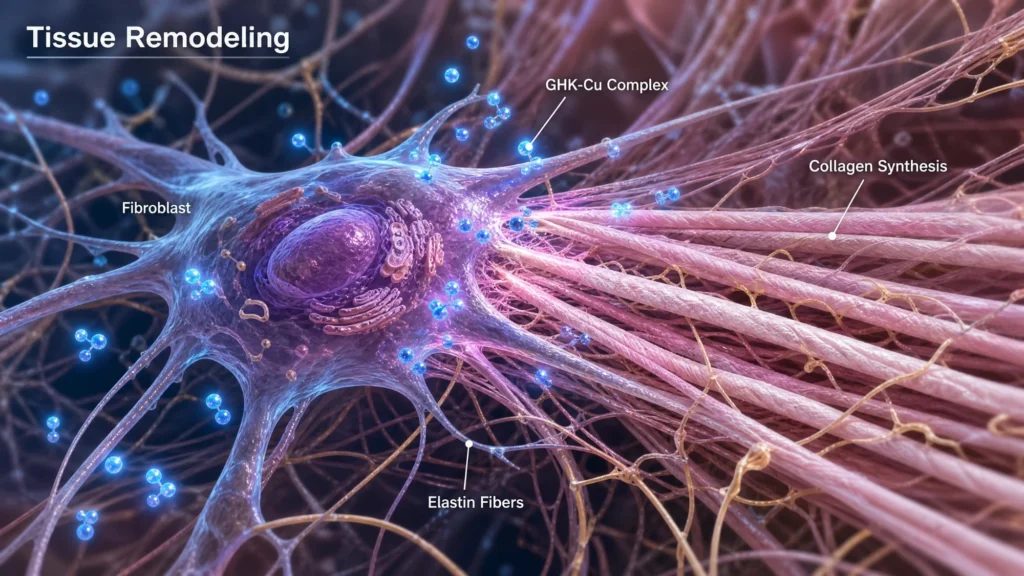
ghk_cu_scientific_illustration

How was the GHK-Cu peptide discovered?

Dr. Loren Pickart made significant strides in the early 1970s while investigating the effects of human plasma on the aging of liver tissues. In his investigations, Dr. Pickart’s team observed that plasma from young individuals possessed a unique ability to restore the function of aged liver cells, whereas plasma from older individuals did not.

Building upon these findings, he isolated the specific active component responsible for this rejuvenation, which was identified as the GHK tripeptide. Further analysis indicated that the peptide’s biological activity was significantly enhanced when complexed with copper. By targeting the fundamental signaling pathways associated with injury and aging, GHK-Cu was developed as a novel research substance to explore the reversal of age-related tissue decline and the promotion of accelerated wound recovery.(3)

Research Studies on GHK-Cu Peptide

GHK-Cu Peptide and Extracellular Matrix Production

The role of GHK-Cu in dermal remodeling was investigated to elucidate its potential to reverse skin thinning and poor elasticity. Using human skin fibroblast cultures, the impact of GHK-Cu was evaluated on collagen synthesis and the underlying molecular mechanisms. This study suggested that GHK-Cu may significantly increase the expression of pro-collagen genes, as compared to findings yielded by the control group. Histological analyses revealed that upon GHK-Cu introduction, it may potentially yield a more organized fiber network and probably result in increased proliferation of basal keratinocytes. Mechanistically, GHK-Cu appears to activate the SMAD signaling pathway, potentially promoting the stabilization of the skin’s structural framework.(4)

GHK-Cu Peptide and Antioxidant Defense

This study aimed to investigate the role of GHK-Cu as a modulator of oxidative stress and DNA protection. Results indicate that GHK-Cu potentially interacts with antioxidant enzymes such as superoxide dismutase (SOD), resulting in potential positive regulation of the cellular defense system. In vitro experiments suggest that the peptide may play a role in DNA repair, as indicated by potential differential regulation of p53 and other repair proteins following UV exposure. Research further suggests that in damaged skin models, the influence of GHK-Cu may synergistically reduce lipid peroxidation and potentially improve the survival rate of cells under metabolic stress. Researchers state that “GHK-Cu disrupted the cycle of oxidative damage and activated intrinsic repair mechanisms in vitro.”(5)

Synopsis

The GHK-Cu peptide appears to be a promising modulator of tissue regeneration and antioxidant signaling pathways. By promoting the synthesis of essential structural proteins and disrupting the negative effects of chronic inflammation, GHK-Cu appears to activate the body’s innate repair mechanisms, potentially leading to enhanced cellular responses and improved tissue quality in research models. Studies have suggested its potential in hair follicle stimulation and accelerating cutaneous wound healing. Further investigations are warranted to fully elucidate its underlying mechanisms and evaluate its applications in scientific research.

NOTE: These products are intended for laboratory research use only. This peptide is not intended for personal use. Please review and adhere to our Terms and Conditions before ordering.

Author

gruppo di ricerca

Follow Me
Other Articles
glutathione_vial
Previous

Glutathione: Research in Cellular Antioxidant Defense and Metabolism

foxo4_dri_vial
Next

FOXO4-DRI Peptide: Research in Senolysis and Cellular Longevity

No Comment! Be the first one.

    Leave a Reply Cancel reply

    Your email address will not be published. Required fields are marked *

    Recent Posts

    • Adamax Peptide: Research in Neuroprotection and Cognitive Augmentation
    • Adipotide (FTTP) Peptide: Research in Targeted Adipose Tissue Vasculature
    • AICAR Peptide: Research in Metabolic Activation and Cellular Energy Homeostasis
    • ARA-290 Peptide: Research in Innate Repair and Neuropathic Protection
    • AOD9604 Peptide: Research in Lipolysis and Cartilage Regeneration

    Recent Comments

    No comments to show.

    Archives

    • October 2025
    • September 2025

    Categories

    • Aesthetics & Performance
    • Healing & Tissue Repair
    • Longevity & Anti-Aging
    • Neuroscience & Nootropics
    • Weight Loss & Metabolic

    Categories

    • Cosmetic (8)
    • Growth (19)
    • Metabolic (22)
    • Neuro (11)
    • Repair (15)
    • Support (2)
    • Systemic (8)

    Hottest Deals

    Hi, I'm Alex. I work in API development research and have in-depth knowledge of the medical, peptide, and health fields.
    • X
    • Instagram
    • Facebook
    • YouTube
    Work Experience

    Shenzhen Research Institute

    Peptide development

    2021-present

    Luxora Digital

    API

    2019-2021

    Southern Medical University

    Support Specialist

    2017-2019

    Available for Hire
    Get In Touch

    Recent Posts

    • adamax_visualization
      Adamax Peptide: Research in Neuroprotection and Cognitive Augmentation
      by gruppo di ricerca
      October 1, 2025
    • hmg_vial.
      HMG: Research in Dual Gonadotropin Signaling and Fertility Models
      by gruppo di ricerca
      September 30, 2025
    • hgh_vial
      HGH: Research in Growth Signaling and Cellular Regeneration
      by gruppo di ricerca
      September 30, 2025
    • hexarelin_vial
      Hexarelin Acetate: Research in GH Secretion and Cardioprotection
      by gruppo di ricerca
      October 1, 2025

    Search...

    Technologies

    raw material

    raw material

    raw material

    raw material

    raw material

    raw material

    raw material

    raw material

    Crystagen_Bioregulator_Peptide_vial
    raw material

    raw material

    Information

    • About Me
    • My story
    • Awards & Achievement
    • Contact

    Welcome to the ultimate source for fresh perspectives! Explore curated content to enlighten, entertain and engage global readers.

    • Facebook
    • X
    • Instagram
    • LinkedIn

    Discover

    • Dresses
    • Bottoms
    • Footwear
    • Accessories

    Latest Posts

    • Tirzepatide Peptide: A Dual-Agonist Approach to Metabolic Research and Weight Regulation
      Tirzepatide is a novel, synthetic peptide that research indicates is… Read more: Tirzepatide Peptide: A Dual-Agonist Approach to Metabolic Research and Weight Regulation
    • Retatrutide Peptide: Research in Triple-Agonist Metabolic Regulation
      May 8, 2026 Retatrutide (also known as LY3437943) is an… Read more: Retatrutide Peptide: Research in Triple-Agonist Metabolic Regulation
    • Ipamorelin Peptide: Research in Selective Growth Hormone Stimulation
      May 13, 2026 Ipamorelin is a synthetic pentapeptide ($Aib-His-D-2-Nal-D-Phe-Lys-NH_2$) that… Read more: Ipamorelin Peptide: Research in Selective Growth Hormone Stimulation

    Locate Us

    123 Demo Blvd, Miami, FL 4567, United States
    +1 123-456-7890
    mail@example.com

    Pages

    • Stories
    • Stories
    • Typography
    • Typography
    • Terms and conditions
    • Terms and conditions

    Contact

    Phone

    +342348343

    +348796543

    Email

    hi@blogsy.com

    support@blogsy.com

    Location

    New York, USA

    Copyright 2026 — 99% Purity Peptide. We are a peptide chemical supplier. Statements on this site have not been evaluated by the FDA. Our products are not for human/animal use and are not intended to diagnose, treat, cure, or prevent any disease. Laboratory/In-Vitro Research Use Only.